


Ad Testing for Agencies: Client-Ready Strategies

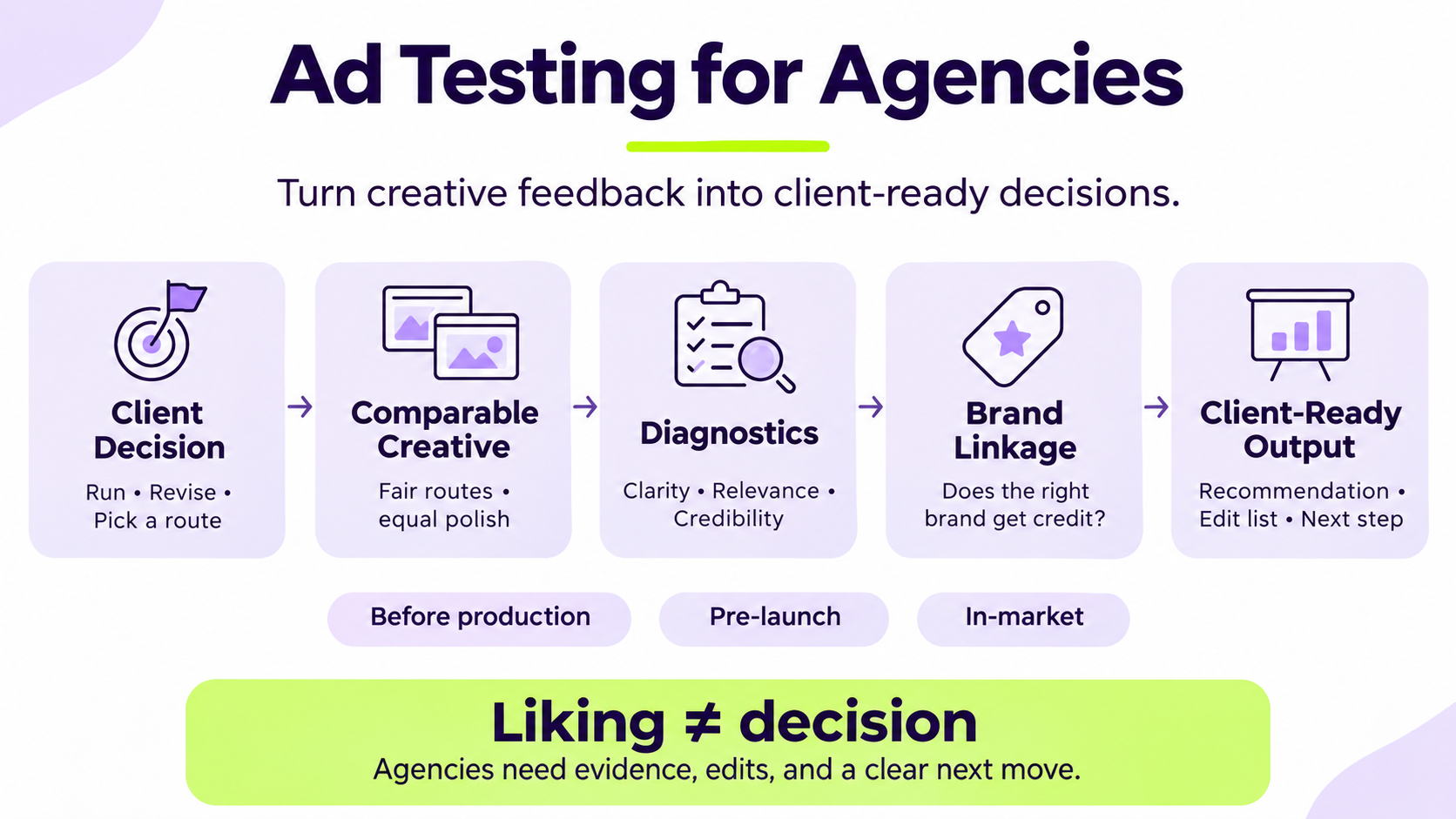
Agencies don’t lose time on ad testing because research is slow—they lose time because results don’t translate into a decision the client will sign. A typical failure mode: the test produces a “winner,” but no one can explain why it won, what to change to improve it, or whether it’s strong enough to justify more media spend. Strong ad testing for agencies is built around a client-facing decision: what creative to run, what to revise, which audience to prioritize, and what proof is required for claims to feel credible. The goal is to move from research/data → insight → business decision → action with a clean evidence trail—so the output is a recommendation (with edits and trade-offs), not a scoreboard.
In Brief
-
Start with the client decision (greenlight, edit, pick a route, shift targeting), then write the test backward.
-
Separate message clarity from design execution so feedback doesn’t become subjective taste.
-
Use diagnostics to identify failure modes: misunderstanding, low relevance, low credibility, or weak brand linkage.
-
Choose methods by stage: early qual for “why,” structured pre-tests for “is it ready,” in-market tests for optimization.
-
Deliver a one-page output: recommendation + evidence + edit list + next step.
Agency moment | What to test | What to measure | Client decision it supports |
Before production | Routes / messages | Comprehension, relevance, claim strength | Which route to produce |
Pre-launch | Rough cuts / layouts | Brand linkage, credibility, persuasion drivers | Greenlight vs rework |
Launch window | Creative variants | Audience response differences, wear-out signals | Optimize media + creative |
Post-campaign | Learning review | What worked, for whom, and why | Next brief improvements |
1) Define the client decision and the “non-negotiables”
Before recruiting participants or choosing a platform, define the decision the client will make with the results. Agencies also need to document constraints: required claims, mandatory assets, legal boundaries, and brand rules. Without these, the test can recommend changes the client cannot implement.
Business decision it improves: A clear greenlight/edit decision tied to what the client can actually change.
2) Ad testing for agencies: pick the right method for the stage
Agencies often default to a single format. Instead, match the method to the uncertainty:
- Exploratory qualitative: when you need “why” and language refinement.
- Structured pre-test: when you need decision-ready diagnostics across variants.
- In-market testing: when you need optimization under real delivery conditions.
Business decision it improves: Faster decisions with fewer “wrong method” disputes.

3) Make stimuli comparable so you’re not “testing polish”
For branding agencies and design agencies, creative polish is part of the work—but if the goal is to compare ideas fairly, keep presentation consistent. If one route is a finished motion piece and the other is a static comp, you’re testing format and finish, not only the message.
Business decision it improves: Which concept is stronger on its merits, and which needs execution improvements.
4) Use diagnostics that translate directly into edits
Clients pay for what the agency will do next. Build the instrument around edit-levers:
- Comprehension: “In your own words, what is this ad about?”
- Main promise extraction: “What benefit is it offering?”
- Relevance: “How well does this fit your needs right now?”
- Credibility: “What makes it believable/unbelievable?”
- Brand linkage: “Which brand is this for?” + “What made you think that?”
- Next action: “What would you do after seeing this?”
Business decision it improves: A specific edit list (opening, claim, proof, branding moments, CTA) with supporting evidence.
5) Sampling: recruit the audience that actually matters to the brief
Agency research gets challenged when the audience doesn’t match the target. Screen on behavior and buying role, not just age or income. If the brief targets switchers, define what a switcher is. If the brief targets decision-makers, ensure you’re not surveying only users.
Business decision it improves: Confidence that findings are relevant to campaign outcomes, not generic preferences.
6) Build a deliverable that clients can approve quickly
Agencies win time by delivering a decision memo, not a deck of charts. Keep it tight:
- Recommendation: run/revise/stop; which version; which audience first.
- Evidence: the 3–5 diagnostics that drove the call.
- Edits: what to change, where, and why.
- Risks: what remains uncertain and what could fail in-market.
- Next test: the smallest follow-up to reduce the biggest risk.
Business decision it improves: Faster client sign-off and fewer rounds of subjective debate.
7) Common agency pitfalls (and how to prevent them)
- Testing too late: no time left to fix the core issue.
- Over-indexing on “liking”: entertaining ads that don’t move behavior.
- Ignoring brand linkage: strong creative that doesn’t credit the right brand.
- Over-claiming precision: treating small differences as decisive.
Business decision it improves: Higher-signal feedback and more defensible recommendations.
A Worked Example
Business/research problem: A branding agency developed two video routes for a new B2C subscription. Route A leads with “save time,” Route B leads with “more control.” The client needs to decide which to produce into multiple cutdowns and scale with paid media.
Research approach: Run a two-stage program: (1) small qualitative sessions to confirm comprehension and surface credibility questions; (2) a structured pre-test (monadic or sequential monadic) to compare diagnostics—clarity, relevance, credibility, and brand linkage—plus open-ended barriers. (Any numbers referenced are hypothetical examples.)
What the data showed (hypothetical example): Route A earned higher initial attention but was often interpreted as “done-for-you service,” which the offer wasn’t. Route B was understood correctly but felt less distinctive unless the ad explained the mechanism.
Insight: The “winner” depended on fixing misunderstanding. Route A needed tighter boundaries and proof; Route B needed clearer differentiation cues.
Business action: Revise Route A’s first 5 seconds and claim language to remove the “done-for-you” misread, then re-test quickly. In parallel, add a single mechanism cue to Route B and test whether differentiation improves. Choose the route to scale only after clarity and credibility thresholds are met.
Expected/observed outcome: Faster client alignment because the agency can show exactly what will be edited and why before committing production and media budgets.
PulseAI Research Insight
For agencies, the value of ad testing is not just picking a winner—it’s producing an evidence-based creative direction that survives stakeholder scrutiny. Teams often get stuck because the research output is a score, not a diagnosis. A research-led approach keeps the chain intact: research → consumer understanding → insights → faster decisions → business action by mapping every measure to a lever the agency can pull (clarity, proof, brand linkage, relevance) and by documenting what remains uncertain.
- What brands should measure: comprehension, credibility, and brand linkage alongside directional persuasion indicators.
- What researchers should investigate: where misinterpretation happens (opening, visuals, claim phrasing) and what proof resolves it.
- What decision the insight can improve: which route to scale, what to edit, and what to validate in-market next.
FAQs
What is ad testing for agencies?
Ad testing for agencies is the process of evaluating creative routes, messages, and executions with the intended audience to guide client decisions. It can happen before production (route testing), before launch (pre-testing), or during campaigns (in-market optimization). The goal is to reduce risk by diagnosing whether the ad is understood, relevant, credible, and clearly linked to the brand—so the agency can recommend specific edits and rollout choices.
How should branding agencies use ad testing?
Branding agencies should use ad testing to pressure-test whether the brand story and promise are interpreted as intended—and whether the creative assets strengthen brand linkage, not just attention. The most useful outputs are diagnostic: where the story confuses, what feels unbelievable, and what visual or verbal cues increase recognition and trust. That enables brand work to translate into campaign-ready, decision-grade creative direction.
How should design agencies use ad testing?
Design agencies can use ad testing to validate clarity and hierarchy: what people notice first, what they think the offer is, and what action they would take. Testing helps identify whether layout choices, typography, imagery, and sequencing support comprehension and brand credit. The key is to keep comparisons fair—if you’re testing design, hold the message constant; if you’re testing message, keep execution comparable.
What should agencies measure in ad testing?
Agencies should measure diagnostics that map to edits: comprehension, relevance, credibility, brand linkage, and perceived differentiation. Include open-ended questions to capture the “why” behind ratings. Directional persuasion or intent measures can be useful for prioritization, but they should be interpreted alongside diagnostics and not treated as a forecast. The goal is to produce a clear recommendation plus an actionable edit list.
How do agencies present ad testing results to clients?
Present results as a decision memo: the recommendation (run/revise/stop), the evidence (key diagnostics and supporting verbatims/themes), and the actions (what to change, where, and why). Explicitly note what remains uncertain and propose the smallest next test to reduce that risk. This format helps clients approve faster because it ties research directly to production and media decisions.
What are common mistakes in agency ad testing?
Common mistakes include testing too late to make meaningful changes, relying on “liking” as the primary KPI, using non-target samples, comparing stimuli with unequal polish, and over-interpreting small score differences. Another issue is delivering a dashboard instead of an action plan. The strongest agency programs treat ad testing as a workflow: diagnose, edit, retest, and document decisions.
Read Similar Blogs
Read Similar Blogs
10 Market Research Techniques That Actually Deliver InsightsThe 4 Types of Consumer Behaviour Every Marketer Must KnowApplication of Consumer Behaviour: How Brands Turn Insights Into GrowthConsumer Research Process: A Step-by-Step Workflow for Better InsightsFactors Influencing Consumer Behaviour and the One Your Research Is Almost...Consumer Insights Data: From Evidence to Brand ActionHow to Create a Survey Questionnaire That Delivers Reliable ResultsDifference Between Research Method and Research Methodology: Clearing Up the...Where Market Research Is Headed: Trends Brands Can’t IgnoreQualitative Consumer Research: Why Customers Behave This WayExploratory Research Design: When and How to Use ItBrand Health vs Brand Equity: Key Metrics and DecisionsConsumer Research Methodology: A Step-by-Step GuideConfusing Survey Questions: 25 Examples and How to Fix ThemWhy Customers Buy: Consumer Behaviour Insights for BrandsQuestionnaire Answer Choices (2026): How to Write Options That Improve Data...Quantitative vs Qualitative Consumer Research: Which One?Consumer Insights Platform: What It Is and How to Choose OneStructured vs Unstructured Questionnaire: Which to UseHow to Build a High-Performing Marketing Research Team That Drives Business...
10 Market Research Techniques That Actually Deliver InsightsThe 4 Types of Consumer Behaviour Every Marketer Must KnowApplication of Consumer Behaviour: How Brands Turn Insights Into GrowthConsumer Research Process: A Step-by-Step Workflow for Better InsightsFactors Influencing Consumer Behaviour and the One Your Research Is...Consumer Insights Data: From Evidence to Brand ActionHow to Create a Survey Questionnaire That Delivers Reliable ResultsDifference Between Research Method and Research Methodology: Clearing Up...Where Market Research Is Headed: Trends Brands Can’t IgnoreQualitative Consumer Research: Why Customers Behave This WayExploratory Research Design: When and How to Use ItBrand Health vs Brand Equity: Key Metrics and DecisionsConsumer Research Methodology: A Step-by-Step GuideConfusing Survey Questions: 25 Examples and How to Fix ThemWhy Customers Buy: Consumer Behaviour Insights for BrandsQuestionnaire Answer Choices (2026): How to Write Options That Improve...Quantitative vs Qualitative Consumer Research: Which One?Consumer Insights Platform: What It Is and How to Choose OneStructured vs Unstructured Questionnaire: Which to UseHow to Build a High-Performing Marketing Research Team That Drives...