


Exploratory Research Design: When and How to Use It

Not every research project begins with a clear question. A brand may see sales slowing without knowing why, or consider a new market without understanding how people there think about the category. Launching a large survey at that point is expensive and risky, because the questionnaire would be built on guesses. Exploratory research design is the stage that turns a vague problem into a precise one. It is flexible, usually small-scale and aimed at learning what to ask, not at measuring how much. This article explains when to use it, the methods involved, how it differs from descriptive and causal studies, how to decide when exploration is enough, and how to convert what you learn into hypotheses and a design for the next stage.
In Brief
- Exploratory research is used when a problem is poorly defined and the goal is to understand it, not to measure it. It uses flexible methods such as interviews, secondary data review and expert input to generate ideas and hypotheses. It does not provide conclusive, generalisable answers and should be followed by more structured research.
- Use it when you cannot yet write a precise research question.
- Combine several flexible methods for a rounded picture.
- Expect directions and hypotheses, not statistics.
- Set a limit so exploration does not drift.
- End with a clear question for the next stage.
Design Types at a Glance
Research type | Purpose | Typical methods | Output |
Exploratory | Understand the problem | Interviews, secondary data, observation | Hypotheses, refined question |
Descriptive | Measure what exists | Surveys, tracking | Shares, profiles, trends |
Causal | Test cause and effect | Experiments, controlled tests | Evidence of impact |
What It Is For
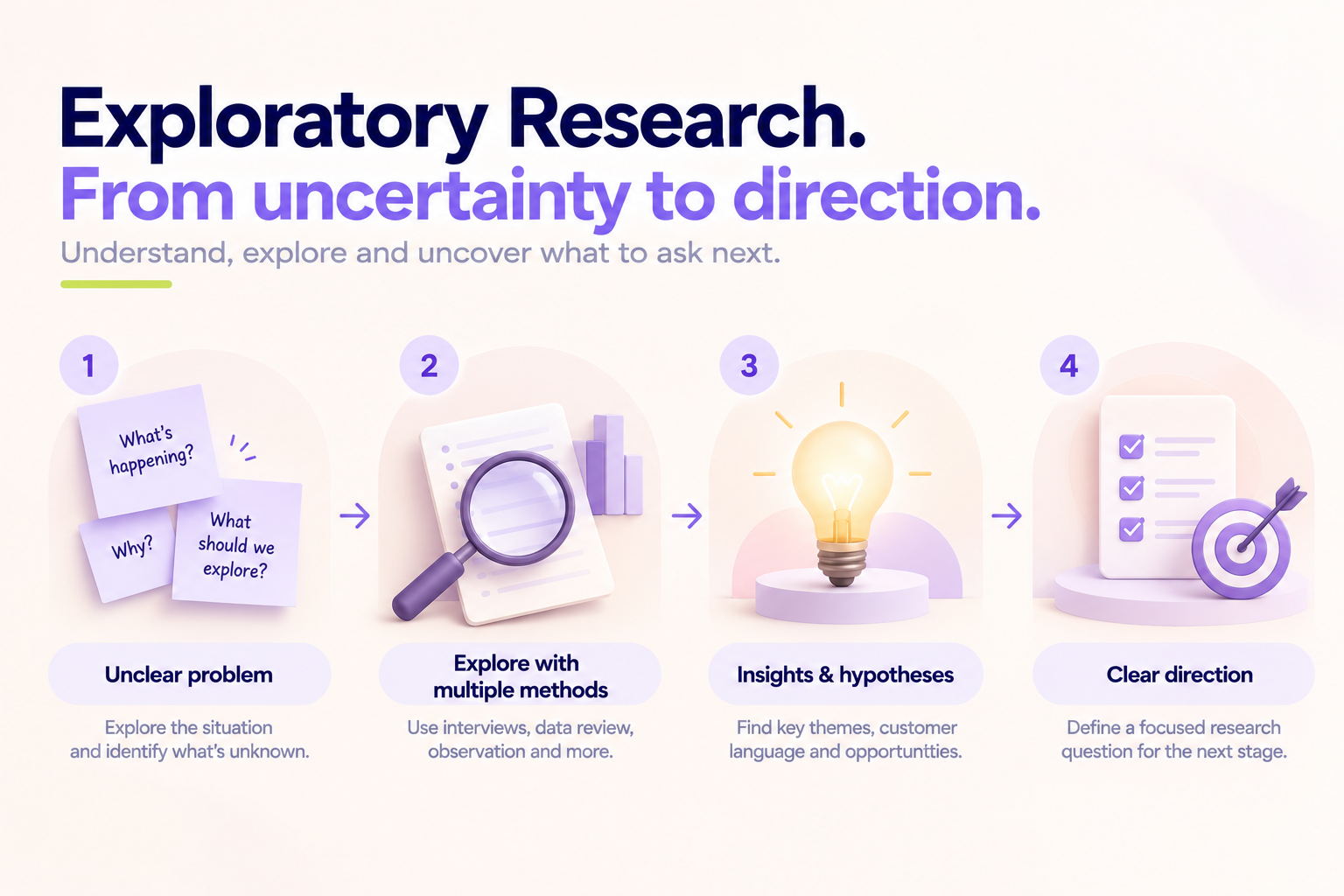
Exploratory research clarifies the problem, identifies relevant variables, discovers language and reveals possibilities. It answers questions like "what is going on here?" and "what should we be asking?"
Methods
- Secondary data review: existing reports, sales data, public data and past studies.
- Expert interviews: people with deep knowledge of the category or channel.
- In-depth interviews: with customers, non-customers or lapsed users.
- Observation: watching how people shop or use a product.
- Social and review analysis: reading what people say unprompted.
- Small informal tests: quick reactions to rough ideas.
Exploratory vs Descriptive Research
Exploratory work is flexible and open, with small, non-representative samples. Descriptive work is structured and aims to measure incidence, profiles and attitudes with samples that can support the claims. Exploration comes first when the question is unclear, while description follows when the question is clear enough to measure.
A Simple Process
- State the problem and what is unknown.
- Review what already exists to avoid repeating work.
- Choose two or three methods that approach the issue from different angles.
- Collect and look for patterns, including surprises and contradictions.
- Write hypotheses that can be tested.
- Define the next-stage design: who to measure, what to ask, how.
Knowing When to Stop
Exploration can run on forever. Stop when new inputs mostly repeat what you already know, when you can write specific, testable questions and when the next step is clear. Setting a time or effort limit at the start helps.
Limits
- Small, non-random samples cannot be generalised.
- Findings depend on the researcher's interpretation.
- Results can be mistaken for conclusions, particularly when they are vivid.

A Worked Example
This is a hypothetical scenario, not a real client case.
Business problem: A packaged-tea brand sees declining sales among younger consumers but does not know why.
Research approach: Review sales and review data, interview category experts and conduct in-depth interviews with younger tea drinkers and lapsed buyers.
What the data showed (illustrative): Younger consumers describe tea as a daily habit but find the brand's formats less convenient than alternatives, and discuss flavour variety in terms the brand does not use.
Insight: The issue may be about format and flavour, not brand image.
Business action: Frame hypotheses about format and flavour, and design a survey measuring their importance among younger buyers.
Expected outcome: A focused follow-up study built on real customer language, rather than internal assumptions.
PulseAI Research Insight
Teams under time pressure often skip straight to a survey, then discover that the questions did not capture what mattered. Exploration is the cheapest stage at which to be wrong.
What businesses often get wrong is treating exploration as optional, or treating its findings as final. It is a preparation step that makes later measurement sharper, and its outputs are hypotheses.
Following exploration with measurement supports Research → Consumer Understanding → Insights → Faster Decisions, since the final study asks the right questions the first time.
- What brands should measure: The hypotheses exploration generates, such as which barriers are most common.
- What researchers should investigate: Language, unexpected themes and contradictions in early inputs.
- What decision the insight can improve: Whether to invest in a larger study, and what it should cover.
FAQs
- What is exploratory research design? It is a flexible research approach used when a problem is not clearly defined. It helps researchers understand the situation, identify relevant factors and generate hypotheses, using methods such as interviews and secondary data review.
- What are common exploratory research methods? Interviews with customers and experts, review of existing data and reports, observation, analysis of online reviews and quick informal tests. Combining a few methods gives a fuller picture than relying on one.
- How is exploratory research different from descriptive research? Exploratory research is open and flexible, aimed at understanding and discovering. Descriptive research is structured and aimed at measuring, using larger samples to estimate shares, profiles and trends.
- How do I know when exploration is enough? When new inputs mostly repeat what you already know and you can state specific, testable questions. Setting a time or effort limit at the start helps prevent drift.
- Can exploratory findings be generalised? Not statistically. Samples are small and not randomly selected. Findings generate ideas and hypotheses, which should be tested with more structured research before major decisions.
- What comes after exploratory research? A more structured stage, often a survey or experiment, that measures or tests the hypotheses identified. The exploratory findings guide who to include, what to ask and how to word the questions.
Read Similar Blogs
Read Similar Blogs
10 Market Research Techniques That Actually Deliver InsightsThe 4 Types of Consumer Behaviour Every Marketer Must KnowApplication of Consumer Behaviour: How Brands Turn Insights Into GrowthConsumer Research Process: A Step-by-Step Workflow for Better InsightsFactors Influencing Consumer Behaviour and the One Your Research Is Almost...Consumer Insights Data: From Evidence to Brand ActionHow to Create a Survey Questionnaire That Delivers Reliable ResultsDifference Between Research Method and Research Methodology: Clearing Up the...Where Market Research Is Headed: Trends Brands Can’t IgnoreQualitative Consumer Research: Why Customers Behave This WayBrand Health vs Brand Equity: Key Metrics and DecisionsConsumer Research Methodology: A Step-by-Step GuideConfusing Survey Questions: 25 Examples and How to Fix ThemWhy Customers Buy: Consumer Behaviour Insights for BrandsObjectives of Marketing Research: The Real DistinctionQuestionnaire Answer Choices (2026): How to Write Options That Improve Data...Quantitative vs Qualitative Consumer Research: Which One?Consumer Insights Platform: What It Is and How to Choose OneStructured vs Unstructured Questionnaire: Which to UseHow to Build a High-Performing Marketing Research Team That Drives Business...
10 Market Research Techniques That Actually Deliver InsightsThe 4 Types of Consumer Behaviour Every Marketer Must KnowApplication of Consumer Behaviour: How Brands Turn Insights Into GrowthConsumer Research Process: A Step-by-Step Workflow for Better InsightsFactors Influencing Consumer Behaviour and the One Your Research Is...Consumer Insights Data: From Evidence to Brand ActionHow to Create a Survey Questionnaire That Delivers Reliable ResultsDifference Between Research Method and Research Methodology: Clearing Up...Where Market Research Is Headed: Trends Brands Can’t IgnoreQualitative Consumer Research: Why Customers Behave This WayBrand Health vs Brand Equity: Key Metrics and DecisionsConsumer Research Methodology: A Step-by-Step GuideConfusing Survey Questions: 25 Examples and How to Fix ThemWhy Customers Buy: Consumer Behaviour Insights for BrandsObjectives of Marketing Research: The Real DistinctionQuestionnaire Answer Choices (2026): How to Write Options That Improve...Quantitative vs Qualitative Consumer Research: Which One?Consumer Insights Platform: What It Is and How to Choose OneStructured vs Unstructured Questionnaire: Which to UseHow to Build a High-Performing Marketing Research Team That Drives...