


Consumer Insights Data: From Evidence to Brand Action

Introduction
A brand can collect thousands of survey responses and still struggle to explain why customers abandon a product. Sales reveal what happened; reviews highlight complaints; interviews uncover expectations. The challenge is connecting these signals into an explanation that supports action. Consumer insights data provides the evidence for understanding needs, motivations, barriers, and buying behaviour. However, collecting information is only the starting point. Researchers must examine who contributed, what was measured, and whether the findings apply to the intended audience. For marketers and product teams, the value lies in translating that evidence into a specific decision: changing a feature, clarifying a claim, testing a price, or improving an experience.
In Brief
- Start with a decision.
- Combine behavioural and attitudinal evidence.
- Check sample relevance.
- Validate interpretations before scaling.
Source | Reveals | Decision supported |
Surveys | Stated preferences | Positioning |
Interviews | Motivations | Product development |
Transactions | Purchase patterns | Assortment |
Reviews | Experience problems | Service improvements |
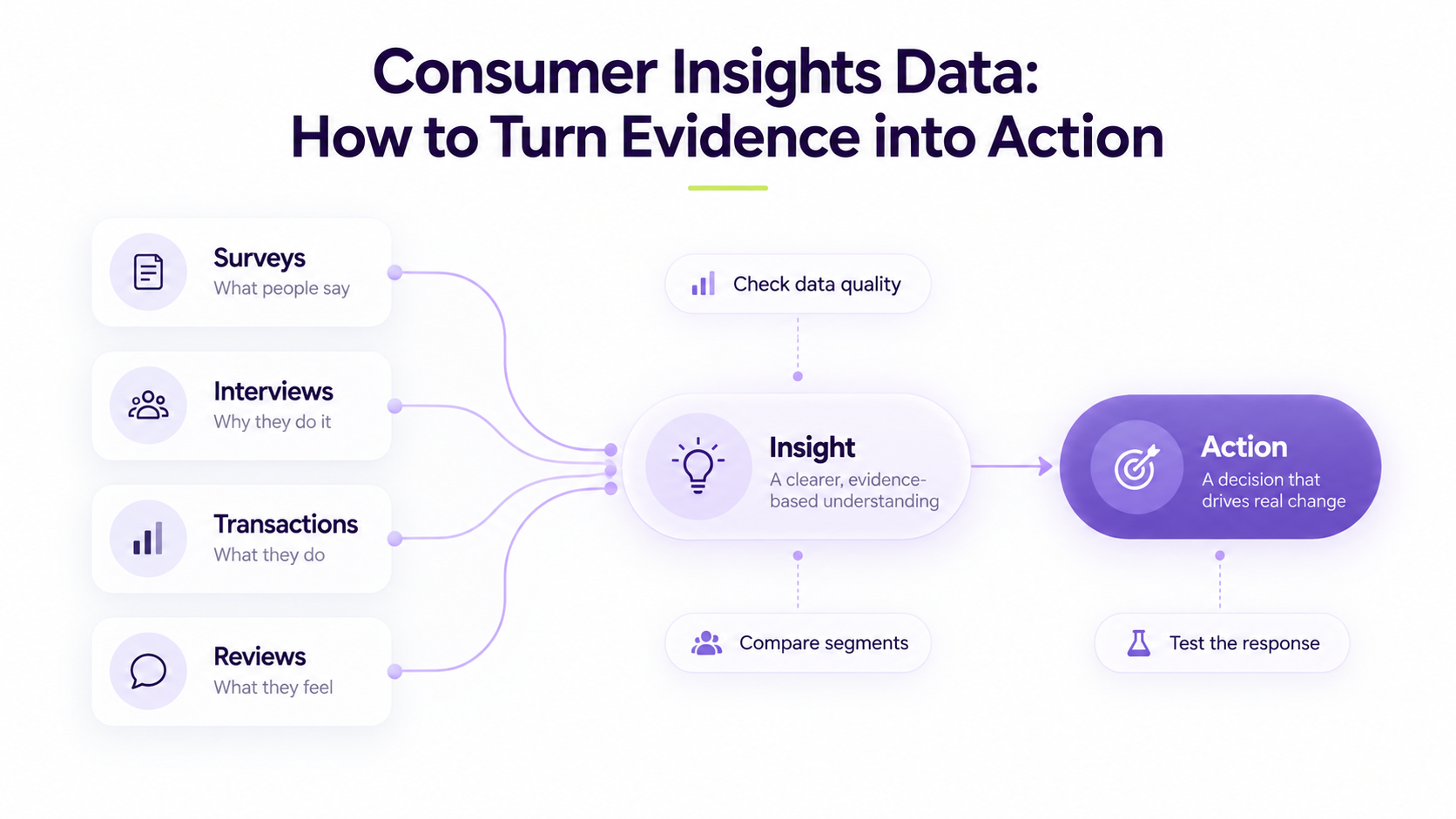
1. Define the Decision
Specify what the research must resolve. “Why do first-time buyers leave?” gives data collection a clearer purpose than “understand customers.”
2. Collect Relevant Consumer Insights Data
Match methods to the question. Interviews explore reasons; surveys assess how widely those reasons occur within the sampled audience.
3. Check Data Quality
Review recruitment, question wording, missing responses, and sample coverage. Large datasets can still exclude important consumer groups.
4. Analyse Meaningful Differences
Compare relevant segments, occasions, and purchase stages. Overall averages may conceal barriers affecting new buyers or particular usage contexts.
5. Separate Observation from Insight
“Customers mention confusing instructions” is an observation. “Uncertainty prevents confident first use” is an interpretation requiring further investigation.
6. Test the Business Response
Assign an owner, intervention, and success measure. Compare outcomes against a baseline or suitable control before expanding the change.

A Worked Example
Hypothetical example: A skincare brand investigates weak repeat purchases through buyer interviews and reviews. Consumers describe uncertainty about application order. The proposed insight is that onboarding friction limits usage. The brand tests clearer instructions and measures usage confidence and repeat purchases. Improvement remains an expected outcome until evaluated.
PulseAI Research Insight
Teams often mistake frequently mentioned topics for business priorities. Investigate which barriers influence behaviour, then connect each finding to a decision owner and measurable action.
FAQs
What qualifies as consumer insights data?
Relevant survey, interview, transactional, observational, and feedback evidence.
Is data itself an insight?
No. Insights explain patterns and their business implications.
Which method works best?
Choose according to the decision and evidence needed.
How often should research run?
Revisit findings when products, audiences, or conditions change.
What is a common mistake?
Treating stated intentions as proof of future purchasing behaviour.
Read Similar Blogs
Read Similar Blogs
10 Market Research Techniques That Actually Deliver InsightsThe 4 Types of Consumer Behaviour Every Marketer Must KnowApplication of Consumer Behaviour: How Brands Turn Insights Into GrowthConsumer Research Process: A Step-by-Step Workflow for Better InsightsFactors Influencing Consumer Behaviour and the One Your Research Is Almost...How to Create a Survey Questionnaire That Delivers Reliable ResultsDifference Between Research Method and Research Methodology: Clearing Up the...Where Market Research Is Headed: Trends Brands Can’t IgnoreQualitative Consumer Research: Why Customers Behave This WayBrand Health vs Brand Equity: Key Metrics and DecisionsConsumer Research Methodology: A Step-by-Step GuideConfusing Survey Questions: 25 Examples and How to Fix ThemWhy Customers Buy: Consumer Behaviour Insights for BrandsObjectives of Marketing Research: The Real DistinctionQuestionnaire Answer Choices (2026): How to Write Options That Improve Data...Quantitative vs Qualitative Consumer Research: Which One?Consumer Insights Platform: What It Is and How to Choose OneStructured vs Unstructured Questionnaire: Which to UseHow to Build a High-Performing Marketing Research Team That Drives Business... Consumer Insights Research: Methods, Frameworks, and Best Practices
10 Market Research Techniques That Actually Deliver InsightsThe 4 Types of Consumer Behaviour Every Marketer Must KnowApplication of Consumer Behaviour: How Brands Turn Insights Into GrowthConsumer Research Process: A Step-by-Step Workflow for Better InsightsFactors Influencing Consumer Behaviour and the One Your Research Is...How to Create a Survey Questionnaire That Delivers Reliable ResultsDifference Between Research Method and Research Methodology: Clearing Up...Where Market Research Is Headed: Trends Brands Can’t IgnoreQualitative Consumer Research: Why Customers Behave This WayBrand Health vs Brand Equity: Key Metrics and DecisionsConsumer Research Methodology: A Step-by-Step GuideConfusing Survey Questions: 25 Examples and How to Fix ThemWhy Customers Buy: Consumer Behaviour Insights for BrandsObjectives of Marketing Research: The Real DistinctionQuestionnaire Answer Choices (2026): How to Write Options That Improve...Quantitative vs Qualitative Consumer Research: Which One?Consumer Insights Platform: What It Is and How to Choose OneStructured vs Unstructured Questionnaire: Which to UseHow to Build a High-Performing Marketing Research Team That Drives... Consumer Insights Research: Methods, Frameworks, and Best Practices