


Beauty & Personal Care Market Research: What Do Today’s Consumers Really Want?


A consumer picks up a serum, reads the ingredient list for ninety seconds, checks three reviews on her phone, and puts it back on the shelf, all before a single salesperson says a word. That entire, silent decision is exactly what beauty and personal care research exists to actually understand, because by the time a brand notices a sales dip, the real story already happened somewhere research never got to look: in that ninety seconds of hesitation, in the specific word on a label that built or broke trust, in the review that tipped the decision one way instead of the other. Beauty is one of the most emotionally loaded, trust-sensitive, and fast-moving categories in consumer research, where a single ingredient claim, a single influencer moment, or a single bad review cycle can reshape purchase behavior within weeks, and brands that rely on assumption instead of real, structured research are making decisions blind in a category where the margin for error keeps shrinking.
Quick Answer
- Beauty & personal care research spans a genuinely wide set of methods, from consumer surveys and segmentation to concept testing, pricing research, and customer experience measurement
- The category has distinct research challenges: fast-moving trends, high emotional and trust sensitivity, and a genuinely fragmented consumer base across skin type, gender, age, and ingredient philosophy
- This guide covers 9 core research areas, each illustrated with real findings from actual PulseAI beauty and personal care studies
- Real examples span 3 genuinely different sub-categories: clean beauty and skincare, men's grooming, and fragrance, showing the breadth this research approach actually covers
- This is the foundational overview, specific trends and deep consumer behavior findings live in dedicated sub-cluster content
Introduction
Beauty and personal care is a category where stated preference and actual behavior diverge constantly, where "I only use natural products" and what's actually in someone's bathroom cabinet don't always match, and where a brand's real understanding of its consumer depends entirely on research methodology sophisticated enough to capture that gap. This guide covers how brands in this category actually conduct research, not as a theoretical list, but grounded in real findings from real PulseAI studies across skincare, men's grooming, and fragrance.
This guide covers:
- The 9 core research areas beauty and personal care brands rely on
- Real, illustrative findings from genuine PulseAI beauty studies
- Why this category has distinct research challenges other categories don't
- Where to go for deeper, category-specific research content
Why Beauty & Personal Care Research Matters for Brands
- The category moves faster than most. Ingredient trends, influencer-driven shifts, and format innovations can reshape consumer expectations within a single season.
- Trust and emotion drive decisions as much as function does. A skincare purchase is rarely just about ingredients; it's tangled up with confidence, identity, and personal ritual.
- The consumer base is genuinely fragmented. Skin type, gender, age, ingredient philosophy, and price sensitivity all shape distinct, sometimes contradictory purchase logic within the same broad category.
- Assumption-based decisions carry real risk here. A single mistimed ingredient claim or a missed shift in consumer definition of "clean" can meaningfully damage trust in a trust-sensitive category.
What Is Beauty & Personal Care Research?
Beauty and personal care research is the structured practice of understanding how consumers in this category think, decide, and behave, spanning surveys, segmentation, concept and pricing testing, brand and trend tracking, and customer experience measurement, applied specifically to a category defined by fast-moving trends and high emotional and trust sensitivity.
The 9 Core Areas of Beauty & Personal Care Research
1. Consumer Surveys
Structured research capturing stated attitudes, preferences, and self-reported behavior directly from beauty consumers, the foundational data layer most other research types build on.
- Real example: PulseAI's clean beauty research surveyed how consumers actually define "clean beauty" themselves, finding 45% define it as "organic and natural" and 35% as "free from harmful chemicals," genuinely distinct definitions requiring different messaging
2. Product Research
Understanding how consumers evaluate, use, and form opinions about specific products and ingredients within the category.
- Real example: the same clean beauty study found both Ayurvedic ingredients and dermatological actives are actively sought simultaneously, revealing a genuinely hybridized skincare mindset rather than a single, simple "natural vs clinical" preference
3. Concept Testing
Evaluating early-stage product or positioning concepts with real consumers before full development or launch commitment.
- Real example: PulseAI's men's grooming research revealed strong openness to experimentation, with sunscreens, serums, and exfoliators identified as the most sought-after new categories, directly informing which concepts are worth developing first
4. Pricing Research
Understanding what consumers are actually willing to pay, and what price signals mean to them beyond the number itself.
- Real example: PulseAI's fragrance category research found 60% of consumers unwilling to spend beyond ₹500 and 75% staying under ₹1,000, revealing genuine price sensitivity even as the category shifts toward higher-performing formats
5. Segmentation
Dividing the consumer base into genuinely distinct groups based on behavior, motivation, or need, per the broader segmentation discipline applied specifically to beauty and personal care.
- Real example: men's skincare research identified distinct usage segments, from basic (face wash plus moisturiser) to minimal, with only a small share engaging in full, multi-step routines, a genuinely different segmentation logic than skincare research built for women
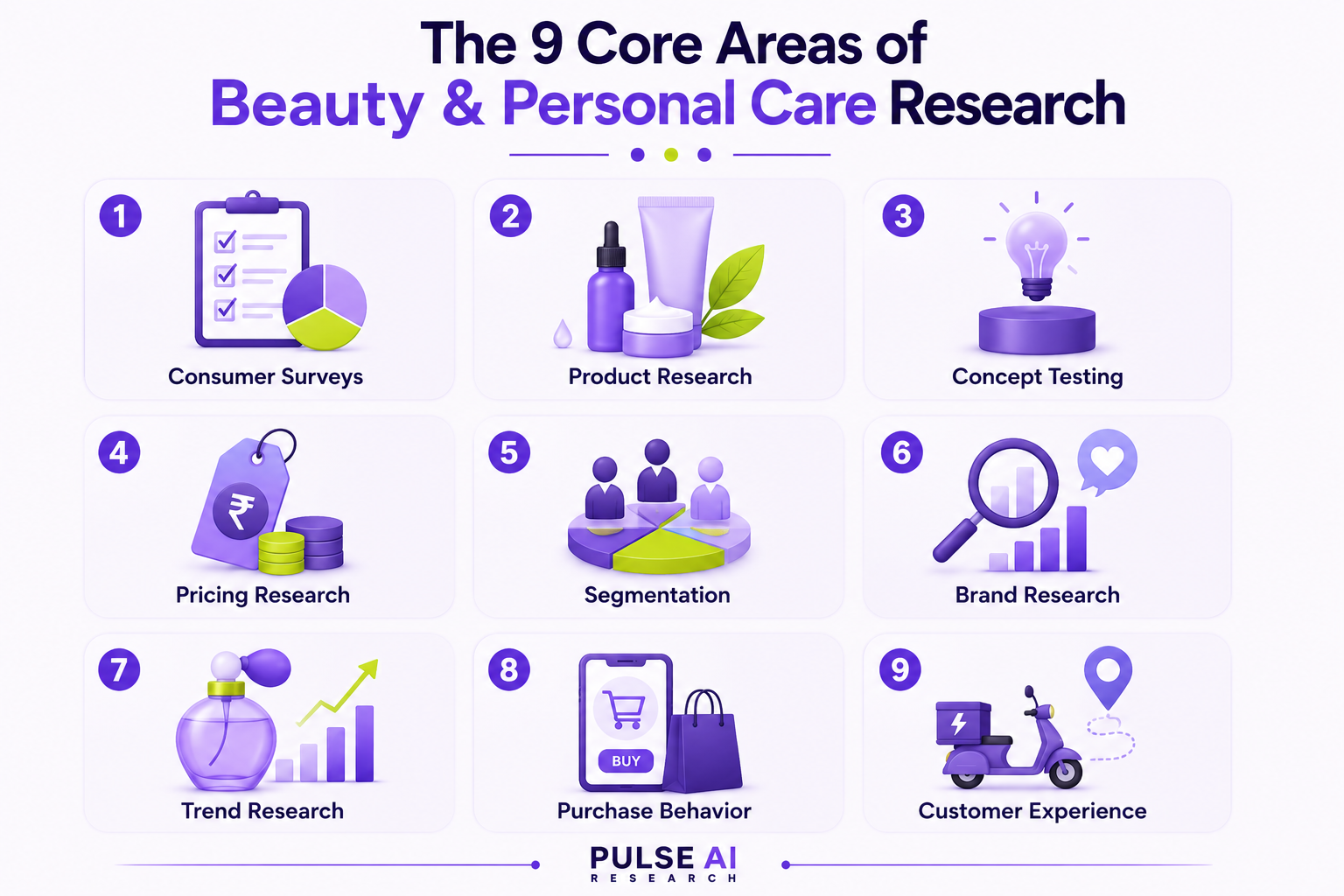
6. Brand Research
Understanding awareness, perception, and trust toward specific brands within the category.
- Real example: the men's grooming study found awareness of established brands exceeding 70%, while actual conversion into comprehensive usage routines remained limited, a real awareness-to-behavior gap worth understanding directly
7. Trend Research
Identifying and validating emerging shifts in consumer preference before they become fully mainstream.
- Real example: PulseAI's fragrance research identified a genuine structural shift, eau de parfums overtaking deodorants as the most popular fragrance type, driven by longevity mattering more to consumers than brand or price
8. Purchase Behavior
Understanding not just what consumers say they want, but how they actually shop and decide, including channel and format preference.
- Real example: the clean beauty study found online platforms dominate purchase behavior at 94%, while dermatologists, not social media or influencers, rank as the most trusted information source, a genuinely important channel-versus-trust distinction
9. Customer Experience
Understanding the full consumer journey and satisfaction, beyond just the initial purchase decision.
- Real example: men's grooming research found over 40% now purchase skincare through quick commerce apps, signaling a genuine shift toward immediacy and convenience shaping the full purchase experience, not just where the sale happens
Comparison: What Each Research Type Actually Reveals
Surveys & Segmentation
- Reveals: Who the consumer is, and how they self-define
- Best for: Foundational understanding and messaging
Concept & Pricing Research
- Reveals: What's worth building, and what it should cost
- Best for: Product and pricing decisions before launch
Brand & Trend Research
- Reveals: Where perception stands, and what's shifting
- Best for: Positioning and timing decisions
Purchase Behavior & CX
- Reveals: How decisions actually happen, end to end
- Best for: Channel strategy and experience design
Real Examples
- A hybridized preference correctly captured: clean beauty research reveals consumers actively seeking both Ayurvedic ingredients and dermatological actives simultaneously, a nuance a simpler "natural vs synthetic" survey question would have missed entirely
- An emerging category identified early: men's skincare research identifies genuine openness to experimentation and specific, sought-after new categories like serums and exfoliators, informing product development ahead of visible market demand
- A structural shift validated through purchase driver data: fragrance research identifies longevity, not brand or price, as the actual top purchase driver, explaining the real shift toward perfumes over deodorants rather than treating it as a passing trend
- A trust gap revealed through channel research: clean beauty research shows online platforms dominate where purchases happen, while dermatologists dominate what's actually trusted, a genuine distinction between transaction channel and information credibility
PulseAI Research Insight
Beauty and personal care brands often have plenty of sales data and far less understanding of the emotional and trust dynamics actually driving those numbers.
PulseAI Research supports the full research spectrum for this category, using Smytten's network of 30M+ active Indian consumers:
- Category-specific studies across skincare, men's grooming, fragrance, and beyond, not generic, cross-category assumptions
- Genuine segmentation depth, capturing how differently men's and women's beauty research, or clean beauty and mainstream beauty consumers, actually need to be understood
- Real purchase driver and pricing research, grounded in actual consumer behavior, not category convention
- 72-hour turnaround, fast enough to inform a real, timing-sensitive product or campaign decision in a genuinely fast-moving category

How Brands Can Use This
- Match the research type to the actual decision you're making. Concept testing for new product ideas, pricing research for launch strategy, segmentation for messaging precision.
- Don't assume beauty consumer behavior generalizes across sub-categories. Men's grooming, clean beauty, and fragrance each show genuinely distinct decision logic.
- Separate transaction channel from trust source. Where consumers buy and what they trust for information are often genuinely different, as clean beauty research shows directly.
- Watch for structural shifts, not just seasonal trends. The deodorant-to-perfume shift reflects a real, durable change in purchase driver priority, not a passing preference.
- Use real category research rather than generic beauty industry assumption. This category moves fast enough that outdated assumptions carry real risk.
Related Concepts
- Market segmentation — the broader segmentation discipline applied specifically to beauty consumers above
- Pricing analytics — deeper methodology behind the willingness-to-pay research referenced above
- Purchase intent survey — the survey instrument underlying much of the consumer research described here
- Brand tracking metrics — the ongoing brand health measurement this category's brand research builds on
- Emerging consumer trends — the early-detection discipline behind identifying shifts like the fragrance category's structural change
FAQs
1.What is beauty and personal care research?
Beauty and personal care research is the structured practice of understanding how consumers in this category think, decide, and behave, spanning surveys, segmentation, concept and pricing testing, brand and trend tracking, and customer experience measurement.
2.Why is beauty and personal care research different from other categories?
Because the category moves unusually fast, ingredient and format trends shift within seasons, and purchase decisions are unusually trust and emotion-driven, requiring research sensitive to both rapid change and the psychological dimension behind beauty purchases.
3.What research methods are most important for beauty brands?
No single method is sufficient alone. Surveys and segmentation build foundational understanding, concept and pricing research inform product decisions, and brand, trend, and purchase behavior research together reveal how consumers actually decide and act.
4.How is men's skincare research different from general skincare research?
Real research shows men's skincare usage clusters into distinct, often shallower routine segments, with stigma and lack of knowledge cited as real barriers, requiring different segmentation and messaging than skincare research built around female consumers.
5.What does clean beauty actually mean to consumers?
Real consumer research shows definitions genuinely vary: many define clean beauty as "organic and natural," while others define it as "free from harmful chemicals," distinct definitions that shape which ingredient and labeling claims actually resonate.
6.Why are perfumes overtaking deodorants in India?
Real fragrance research identifies longevity, not brand or price, as the primary purchase driver, with deodorants underdelivering against that specific expectation while affordable perfumes now offer comparable performance at accessible price points.
7.Where should beauty brands go for deeper category-specific research?
This pillar covers the foundational research approach; deeper findings on specific trends, segments, and behaviors within beauty and personal care live in dedicated sub-cluster content, linked as it becomes available.
Read Similar Blogs
Read Similar Blogs
10 Market Research Techniques That Actually Deliver InsightsThe 4 Types of Consumer Behaviour Every Marketer Must KnowMarket Research Steps: A Practical Framework for Brand Teams Who Need...Application of Consumer Behaviour: How Brands Turn Insights Into GrowthPrimary Research: A Practical Guide for Brand TeamsConsumer Research Process: A Step-by-Step Workflow for Better InsightsFactors Influencing Consumer Behaviour and the One Your Research Is Almost...Consumer Insights Data: From Evidence to Brand ActionContingency Question in Surveys (Skip Logic Guide)How to Create a Survey Questionnaire That Delivers Reliable ResultsDifference Between Research Method and Research Methodology: Clearing Up the...Where Market Research Is Headed: Trends Brands Can’t IgnoreQualitative Research Questions: How to Ask Better Questions for Deeper Consumer...Qualitative Consumer Research: Why Customers Behave This WayExploratory Research Design: When and How to Use ItBrand Health vs Brand Equity: Key Metrics and DecisionsConsumer Research Methodology: A Step-by-Step GuideConfusing Survey Questions: 25 Examples and How to Fix ThemWhy Customers Buy: Consumer Behaviour Insights for BrandsQualitative Research Techniques: How to Extract Better Consumer Insights
10 Market Research Techniques That Actually Deliver InsightsThe 4 Types of Consumer Behaviour Every Marketer Must KnowMarket Research Steps: A Practical Framework for Brand Teams Who Need...Application of Consumer Behaviour: How Brands Turn Insights Into GrowthPrimary Research: A Practical Guide for Brand TeamsConsumer Research Process: A Step-by-Step Workflow for Better InsightsFactors Influencing Consumer Behaviour and the One Your Research Is...Consumer Insights Data: From Evidence to Brand ActionContingency Question in Surveys (Skip Logic Guide)How to Create a Survey Questionnaire That Delivers Reliable ResultsDifference Between Research Method and Research Methodology: Clearing Up...Where Market Research Is Headed: Trends Brands Can’t IgnoreQualitative Research Questions: How to Ask Better Questions for Deeper...Qualitative Consumer Research: Why Customers Behave This WayExploratory Research Design: When and How to Use ItBrand Health vs Brand Equity: Key Metrics and DecisionsConsumer Research Methodology: A Step-by-Step GuideConfusing Survey Questions: 25 Examples and How to Fix ThemWhy Customers Buy: Consumer Behaviour Insights for BrandsQualitative Research Techniques: How to Extract Better Consumer Insights