


ML Tools for Market Research: What to Use and How to Evaluate Them

 ML Tools for Market Research: A No-Nonsense Evaluation Guide
There are more ML tools in the market research technology stack in 2026 than any research team can reasonably evaluate, and before comparing any of them, machine learning in market research: methods and applications covers the foundational methods layer that all of these tools are built on.
The problem is not finding tools. It is that most vendor comparisons focus on features and demo quality, which tells you almost nothing about whether a tool will produce reliable outputs when applied to your actual consumer data. This guide cuts through the noise with a category framework, specific evaluation criteria, and the questions that surface real capability from marketing copy.
The Five ML Tool Categories in Market Research
Not all ML research tools are solving the same problem. Knowing which category a tool belongs to tells you which evaluation criteria apply.
Category 1: NLP Open-Ended Analysis Platforms
What they do: Apply ML models to consumer text data including open-ended survey responses, customer reviews, support transcripts, and social verbatims. Output: themes, sentiment scores, verbatim clusters, and language drift analysis.
Examples: Kapiche, Thematic, Medallia Text Analytics, Qualtrics Text iQ, Relative Insight.
Best for: Any programme with 500 or more consumer verbatims per wave where manual coding is a significant time cost.
 Watch out for: Platforms that output theme labels without representative verbatims. Seeing that a theme appears in 18% of responses is less useful than seeing the actual consumer language that defines it.
Category 2: Predictive Consumer Analytics Platforms
What they do: Train ML models on historical consumer data to produce forward-looking probability scores for churn risk, trial propensity, and purchase intent.
Examples: DataRobot, H2O.ai, Salesforce Einstein Analytics, Adobe Analytics with ML features.
Best for: Organisations with 18 or more months of tracking history and 50,000 or more consumer records. Below this data threshold, the predictions carry confidence intervals too wide for commercial use.
The honest data requirement:
Predictive ML platforms are high-value when data assets are sufficient. They are expensive analysis of insufficient data when they are not. Ask any vendor for the minimum data requirements that produce predictions at commercially useful confidence levels before signing a contract.
For how the data architecture behind predictive ML models needs to be built from the research programme design upward, <u>predictive analytics in market research: methods and applications</u> covers the methodology and data requirements in full.
Category 3: Real-Time Survey Quality Control Systems
What they do: Apply ML anomaly detection to survey completion behaviour during fieldwork, flagging and replacing low-quality respondents within the active fielding window.
Examples: Forsta Quality Control, Confirmit QC features, Decipher QC modules, platform-native quality systems.
Best for: Any quantitative market research programme where data quality is commercially critical and replacement fieldwork is expensive.
Three signals these systems monitor:
- Per-question response time patterns (not just total completion time)
- Cross-question logical consistency
- Response variance across grid and battery items
Why this category is the most underused relative to its value: Almost every quantitative programme benefits from real-time quality control. Most teams still run post-hoc quality cleaning. The cost difference between the two approaches includes the cost of replacement fieldwork, additional analyst time, and delayed delivery.
Category 4: Automated Consumer Segmentation Platforms
What they do: Apply unsupervised ML clustering to survey attitudinal data to identify natural consumer groupings without pre-specified segment definitions.
Examples: SPSS with ML clustering, R and Python ML libraries, Displayr with ML segmentation, Q Research Software.
Best for: Usage and attitude studies, brand equity studies, and any programme where consumer segmentation is a primary deliverable.
The key advantage over traditional segmentation tools:
Traditional segmentation software clusters on researcher-defined variables. ML segmentation platforms cluster on the full response profile simultaneously. The resulting segments are defined by consumer reality rather than researcher assumption, and they typically show stronger behavioural predictiveness in holdout validation.
Category 5: Adaptive Survey and Conjoint Platforms
What they do: Apply ML to adjust survey instrument design in real time during fieldwork, concentrating question exposure in the utility space most informative for each individual respondent.
Examples: Sawtooth Software ACBC, 1000minds, Conjointly.
Best for: Pricing research, product portfolio optimisation, and feature prioritisation studies where individual-level preference heterogeneity is commercially important.
When not to use it: Adaptive conjoint platforms require larger sample sizes than standard CBC conjoint, typically 300 or more respondents minimum, and experienced conjoint researchers to interpret the individual-level utility distributions correctly. For most standard feature importance or concept evaluation studies, standard CBC at lower cost and complexity produces adequate outputs.
For how conjoint ML techniques specifically produce more behaviourally valid price sensitivity data than stated intent questions, conjoint analysis willingness to pay: measuring price sensitivity through trade-off research covers the methodology.

The Evaluation Framework: Five Questions That Predict Real Value
Before committing budget to any ML market research tool, require specific answers to these:
Question 1: What model is doing the ML work? General-purpose language model or domain-trained consumer research model? Domain-trained models produce more reliable consumer insight outputs. Ask specifically what training data the model was built on.
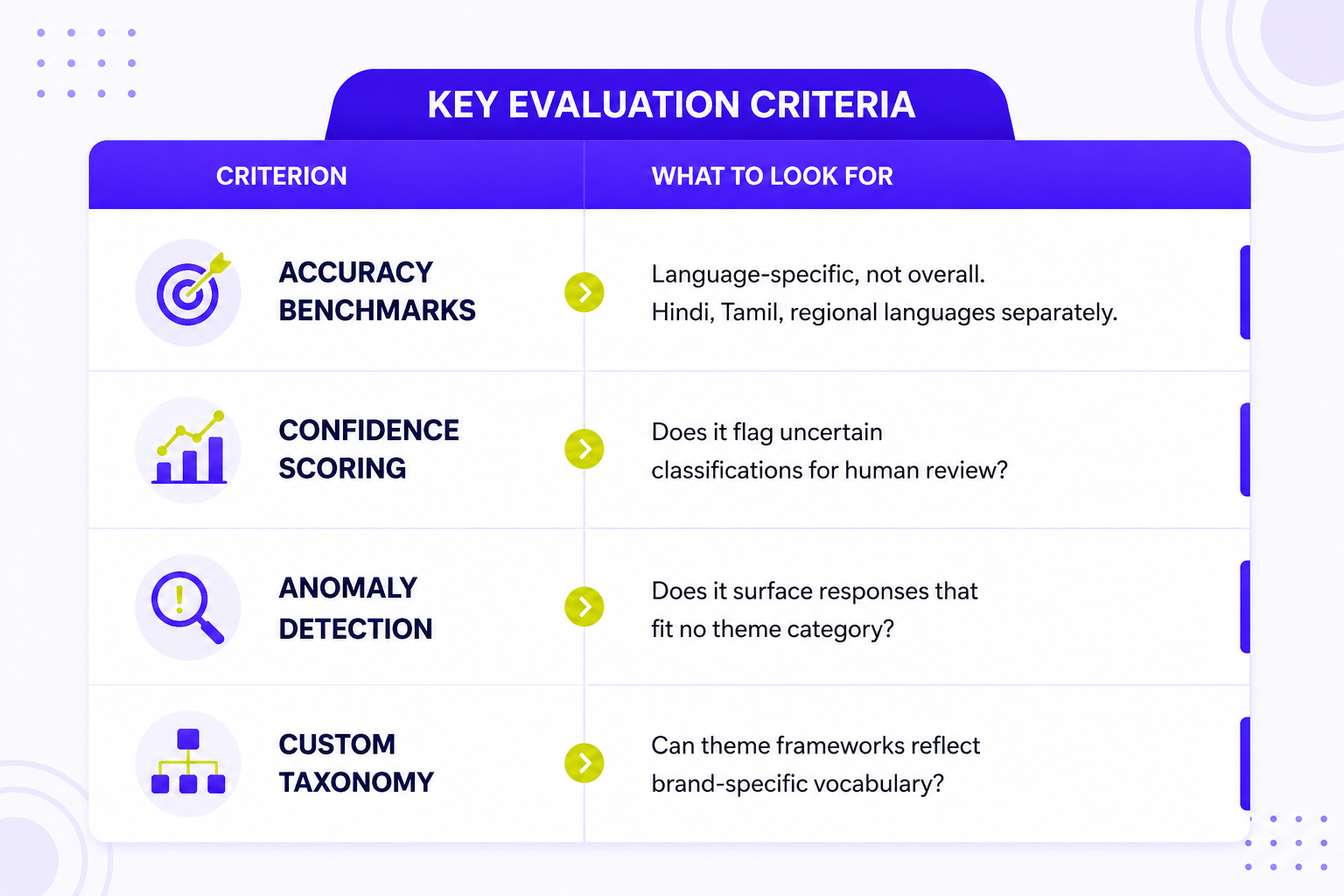
Question 2: What are the accuracy benchmarks for your languages? For Indian consumer research: Hindi, Tamil, Telugu, Bengali, Kannada accuracy separately. Not aggregate NLP accuracy. Language-specific verified benchmarks.
Question 3: How does the tool handle uncertain outputs? Does it surface low-confidence classifications for human review? A tool that presents all outputs with equal visual confidence is hiding its own uncertainty. This is a research quality risk.
Question 4: How much researcher time does the output require post-delivery? The actual ROI metric. Tools that require 40% output correction add an analytical step rather than remove one. Test on your own data, not a vendor demo dataset.
Question 5: Can you show me a failure case? Ask the vendor to demonstrate a case where the ML produced an incorrect or misleading output and explain how it was detected and corrected. A vendor who cannot answer this question is either uninformed or not being transparent about limitations every ML system has.
Quick Comparison: Tool Categories at a Glance
NLP Open-Ended Analysis Best for: Open-ended verbatim coding at scale Data requirement: 200 or more verbatims per wave ROI threshold: High for most research programmes
Predictive Analytics Best for: Churn prediction, trial propensity, purchase driver modelling Data requirement: 50,000 or more records, 18 months history minimum ROI threshold: High when data assets are sufficient; unreliable without them
Real-Time Quality Control Best for: Any quantitative fieldwork programme Data requirement: Active integration with survey platform ROI threshold: High across all programme types; most underused category
Automated Segmentation Best for: U&A studies, brand equity studies, consumer profiling Data requirement: Minimum 200 respondents per segment for validation ROI threshold: Moderate to high depending on programme type
Adaptive Conjoint Best for: Pricing research, portfolio optimisation Data requirement: 300 or more respondents minimum ROI threshold: High for specific applications; unnecessary for most
FAQ
What are the best ML tools for market research in 2026?
The best ML tool depends entirely on the specific research application. NLP open-ended analysis platforms deliver the highest ROI for the most research programmes because verbatim coding was previously the most labour-intensive analytical task. Real-time quality control tools deliver the most consistently underappreciated value across all programme types. Predictive analytics platforms deliver the highest strategic impact but only when data assets meet minimum requirements.
How should a market research team evaluate ML tools?
Evaluate on five criteria: the ML model training data and domain specificity, language-specific accuracy benchmarks for your target consumer markets, confidence scoring and uncertain output handling, actual researcher time required post-delivery measured on your own data, and the vendor's transparency about failure cases.
Are ML tools suitable for Indian market research?
With important caveats. Most major ML research platforms were primarily built on English-language data. Performance on Hindi and regional Indian language consumer data varies significantly. Independent language accuracy validation for your specific markets is essential before committing to any platform for multilingual Indian consumer research programmes.
Conclusion
The ML tools market for market research in 2026 is mature enough to deliver genuine efficiency gains and still immature enough to mislead teams who evaluate on demo quality rather than real-world research performance.
The framework is simple: test on your data, measure actual researcher time, demand language-specific accuracy benchmarks, and ask for a failure case. The tools that pass those tests are worth investing in.
Pulse AI Research integrates ML-powered analysis into structured consumer research programmes for Indian brand teams, with language coverage and quality specifications designed for the full Indian consumer market.
Read Similar Blogs
Read Similar Blogs
10 Market Research Techniques That Actually Deliver InsightsMarket Research Steps: A Practical Framework for Brand Teams Who Need...Primary Research: A Practical Guide for Brand TeamsConsumer Research Process: A Step-by-Step Workflow for Better InsightsFactors Influencing Consumer Behaviour and the One Your Research Is Almost...Difference Between Research Method and Research Methodology: Clearing Up the...Where Market Research Is Headed: Trends Brands Can’t IgnoreHypothesis Testing in Research Methodology: A Practical GuideQualitative Research Questions: How to Ask Better Questions for Deeper Consumer...Quantitative Research Methodology: A Complete Guide for Brand Research TeamsConsumer Research Methodology: A Step-by-Step GuideLikert Scale Survey Design: How to Use the Most Common Measurement Tool...Brand Tracking vs Brand Research: Ultimate Guide for Marketers and AnalystsWhy Customers Buy: Consumer Behaviour Insights for BrandsQualitative Research Techniques: How to Extract Better Consumer InsightsObjectives of Marketing Research: The Real DistinctionAdvanced AI Research Methods in Market Research MetaQuantitative vs Qualitative Consumer Research: Which One?Consumer Insights Platform: What It Is and How to Choose OneFeedback Survey Questions Template: Designing Surveys That Turn Input Into...
10 Market Research Techniques That Actually Deliver InsightsMarket Research Steps: A Practical Framework for Brand Teams Who Need...Primary Research: A Practical Guide for Brand TeamsConsumer Research Process: A Step-by-Step Workflow for Better InsightsFactors Influencing Consumer Behaviour and the One Your Research Is...Difference Between Research Method and Research Methodology: Clearing Up...Where Market Research Is Headed: Trends Brands Can’t IgnoreHypothesis Testing in Research Methodology: A Practical GuideQualitative Research Questions: How to Ask Better Questions for Deeper...Quantitative Research Methodology: A Complete Guide for Brand Research...Consumer Research Methodology: A Step-by-Step GuideLikert Scale Survey Design: How to Use the Most Common Measurement Tool...Brand Tracking vs Brand Research: Ultimate Guide for Marketers and AnalystsWhy Customers Buy: Consumer Behaviour Insights for BrandsQualitative Research Techniques: How to Extract Better Consumer InsightsObjectives of Marketing Research: The Real DistinctionAdvanced AI Research Methods in Market Research MetaQuantitative vs Qualitative Consumer Research: Which One?Consumer Insights Platform: What It Is and How to Choose OneFeedback Survey Questions Template: Designing Surveys That Turn Input Into...